Introduction
Many businesses use federated identity. Examples are SAML and OpenID Connect, which is an identity layer on the OAuth 2.0 protocol. In these systems, a trusted third party (for example Google, Microsoft, or Okta) vouches for the identity of a user. This model works, but it has structural tradeoffs: data ownership, single points of failure, and vendor lock-in. Self-sovereign identity (SSI) is a different model.
How Federated Identity Works
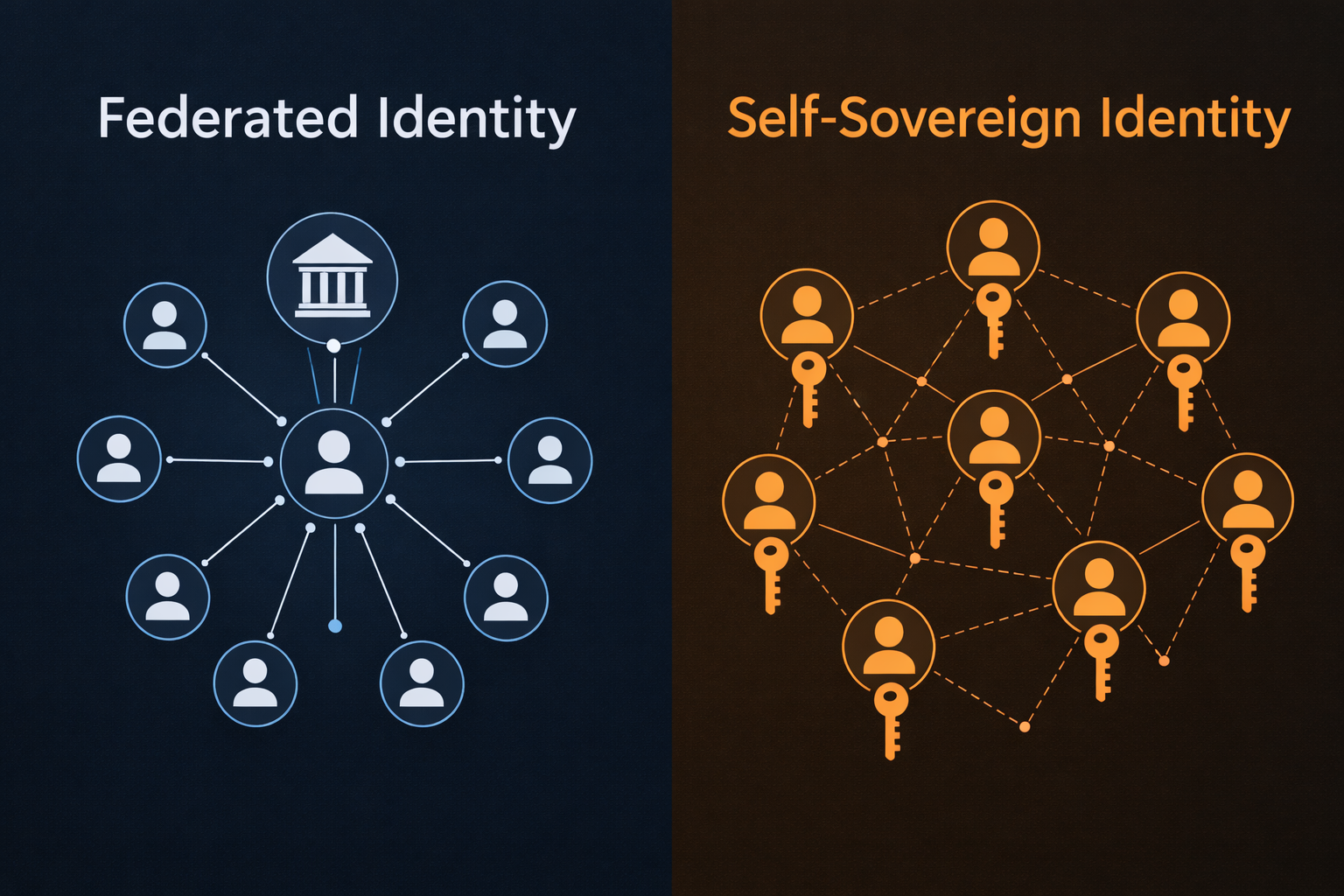
In federated identity, an Identity Provider (IdP) is at the center (NIST SP 800-63C-4):
- A user authenticates with the IdP (for example, "Sign in with Google").
- The IdP issues a token to the relying party (your application).
- Your application trusts the token because it trusts the IdP.
This model works well for the web. It has standards and wide support. Also, each application does not need its own credential store. But the architecture has limits.
The Problems with Federation
Centralized control
The IdP controls the identity relationship. If Google disables an account, the user cannot sign in to Google services or use Sign in with Google. What happens to sessions that already exist depends on each service. To get the account back, the user must use the Google appeal process. The same Google page says that users in the European Union can have additional options.
Data aggregation
The IdP sees each authentication event. NIST SP 800-63C-4 says that each federation request shows the IdP where the subscriber signs in. Over time, the IdP can build a profile of the relying parties that each subscriber uses. This metadata has value, and it causes privacy risks, independent of the privacy policy of the IdP. The OpenID Connect privacy considerations address a related risk: correlation between relying parties. For that risk, they recommend that implementers consider pairwise pseudonymous identifiers.
Availability dependency
If the IdP is not available, users cannot sign in to the services that depend on it. One outage at a large provider can affect many services that have no other connection to each other.
Vendor lock-in
A change of identity provider is difficult. In OpenID Connect, the only stable identifier for a user is the combination of the iss (issuer) and sub (subject) Claims. Thus user identifiers are specific to the provider. If you change the provider, each integrated service must link its user accounts to new identifiers.
How Self-Sovereign Identity Differs
SSI reverses the model. A central provider does not issue and control identities. Instead, individuals hold their own credentials. The architecture uses open standards from the W3C:
- DIDs (Decentralized Identifiers): The user controls a globally unique identifier. The DID Core specification says that DIDs can be "decoupled from centralized registries, identity providers, and certificate authorities". Many DID methods anchor DIDs to a decentralized network, for example the Bitcoin blockchain, IPFS, or a DHT. With these methods, no identity provider can revoke the DID. The properties depend on the DID method: for example, the domain owner controls a did:web DID.
- Verifiable Credentials: Trusted issuers (employers, universities, governments) issue signed credentials directly to the wallet of the user. With selective disclosure, the user shows only the claims that an interaction needs, not the full credential. Two techniques are BBS signatures and SD-JWT (RFC 9901). BBS makes zero-knowledge proofs that do not show the signature, so presentations are unlinkable. SD-JWT is a simpler disclosure mechanism for JWTs.
- Digital Wallets: Software that manages the DIDs, keys, and credentials of the user. The wallet is the agent of the holder in the roles of issuer, holder, and verifier.
The relying party verifies the signature of the credential with the public key in the DID document of the issuer. This verification needs no real-time connection to the issuer. But the verifier can need a Bitstring Status List to check if the issuer revoked the credential. The verifier can cache this list, and the issuer can serve it through a content distribution network (CDN). Then the issuer does not see each check, and the privacy of the holder increases.
What This Means for Businesses
Reduced liability
If you do not collect and store identity data about users, you cannot leak it. With SSI-based verification, the user presents a proof. Thus you can keep less personally identifiable information (PII) in your databases.
Simplified compliance
GDPR, the CCPA, and similar regulations put obligations on organizations that collect personal data, independent of the delivery mechanism. If you receive personal data in a verifiable credential presentation, you can still be a controller under GDPR Article 4(7). But selective disclosure and zero-knowledge proofs can reduce the personal data that you must collect. For example, a verifier can check that a user is over 18 without the birthdate. Less data means fewer compliance obligations: fewer storage obligations, lower breach risk, and simpler data subject access requests.
Resilience
No single identity provider can stop your authentication flow. With a decentralized DID method, DID resolution does not depend on one company. It depends on the decentralized network below the DID method (for example Bitcoin) and on the availability of the DID data.
Interoperability
The W3C DID and Verifiable Credential standards are vendor-neutral W3C Recommendations (DID v1.0 in July 2022, VC Data Model v2.0 in May 2025). A system can verify credentials from another system without a bilateral integration agreement. Both systems must support the same DID methods and the same mechanisms to secure credentials.
The Transition Path
SSI does not require that you replace your current infrastructure at once. We recommend these practical steps:
- Hybrid authentication: Accept both federated tokens and verifiable credential presentations during a transition period.
- Credential issuance: Issue verifiable credentials to your own users, in parallel with your current identity flows.
- Verification first: Before you issue credentials, accept credentials from external issuers for specific use cases (age verification, professional certifications, KYC).
Conclusion
Federated identity solved real problems, but it also created problems of centralization, privacy, and control. Self-sovereign identity addresses these structural problems, because individuals control their own credentials. For businesses, SSI can reduce liability, reduce the data that you must collect and protect, and remove dependencies on one provider. The tradeoff is more complexity: key management, the credential lifecycle, revocation infrastructure, and a less mature ecosystem than federation protocols. We expect both models to exist together for a long time. For many organizations, a hybrid approach is a practical way forward.
References
- W3C Decentralized Identifiers (DIDs) v1.0, W3C Recommendation
- W3C Verifiable Credentials Data Model v2.0, W3C Recommendation
- W3C Bitstring Status List v1.0, W3C Recommendation for credential status and revocation
- OpenID Connect Core 1.0, with Section 17 on privacy considerations
- RFC 6749 - The OAuth 2.0 Authorization Framework
- RFC 9901 - Selective Disclosure for JWTs (SD-JWT), IETF Proposed Standard (November 2025)
- BBS Signatures (IRTF CFRG draft), unlinkable selective disclosure. As of September 2026, this draft is not an RFC.
- Christopher Allen - The Path to Self-Sovereign Identity (April 2016), with the ten SSI principles that Allen proposed
- NIST SP 800-63C-4 - Federation and Assertions (July 2025)